Eddie Cochran
Edward Raymond 'Eddie' Cochran (October 3, 1938 – April 17, 1960) was an American musician. Cochran's rockabilly songs, such as "C'mon Everybody", "Somethin' Else", and "Summertime Blues", captured teenage frustration and desire in the late 1950s and early 1960s.[1] He experimented with multitrack recording and overdubbing even on his earliest singles,[2] and was also able to play piano, bass and drums. His image as a sharply dressed but rugged and good-looking young man with a rebellious attitude epitomized the stance of the 50s rocker, and in death he achieved an iconic status.
Cochran was born in Minnesota and moved with his family to California in the early 1950s. He was involved with music from an early age, playing in the school band and teaching himself to play blues guitar.[4] In 1955, he formed a duet with the guitarist Hank Cochran (no relation), and when they split the following year, Cochran began a song-writing career with Jerry Capehart. His first success came when he performed the song "Twenty Flight Rock" in the movie The Girl Can't Help It, starring Jayne Mansfield. Soon afterwards, Liberty Records signed him to a recording contract.
Cochran died aged 21 after a road accident, whilst travelling in a taxi, in the town of Chippenham, Wiltshire during his British tour in April 1960 having just performed at Bristol's Hippodrome theatre. Though his best-known songs were released during his lifetime, more of his songs were released posthumously. In 1987 Cochran was inducted into the Rock and Roll Hall of Fame. His songs have been much covered by bands such as The Who, The Beach Boys, The Beatles, The Rolling Stones, The Move, Dick Dale & his Del-Tones, Blue Cheer, Led Zeppelin, Rush, Humble Pie, Commander Cody and His Lost Planet Airmen, Joan Jett and the Blackhearts, Teenage Head, Tiger Army, UFO, The White Stripes, the Stray Cats, and the Sex Pistols
Ray Smith (rockabilly singer)
Ray Smith (October 30, 1934 – November 29, 1979) was an American rockabilly musician.
Smith recorded for Vee-Jay Records, Tollie Records, Smash Records, and Sun Records during his career, and had a hit with the song "Rockin' Little Angel" in 1960 on Judd Records. "Rockin' Little Angel" took a portion of its melody from the 1844 song "Buffalo Gals". The record sold over one million copies, earning a gold disc. Smith often recorded material written by Charlie Rich, and was heavily influenced by Elvis Presley.
Smith committed suicide on November 29, 1979, at the age of 45. Smith's Judd and Sun singles and session material have been released on Germany's Bear Family Records.
References
Jump up ^ Rockabillyhall.com - accessed May 2009
^ Jump up to: a b Review, Allmusic
^ Jump up to: a b Joel Whitburn, The Billboard Book of Top 40 Hits. 7th edn, 2000
Jump up ^ Murrells, Joseph (1978). The Book of Golden Discs (2nd ed.). London: Barrie and Jenkins,. p. 129. ISBN 0-214-20512-6.
Ray Smith Info
Born October 30, 1934
Origin Melber, Kentucky
Died November 29, 1979 (aged 45)
Genres Rock and roll, Rockabilly, R&B, C&W
Occupations Singer, songwriter, musician
Instruments Vocals, piano
Years active 1956–1979
Labels Sun Records
Judd Records
Vee-Jay Records
Tollie Records
Smash Records
Various independent record labels
Associated acts Ray Smith and the Country Boys (1956)
Dave Edmunds
David William "Dave" Edmunds (born 15 April 1944) is a Welsh singer, guitarist and record producer. Although he is primarily associated with pub rock and New Wave, and had numerous hits in the 1970s and early 1980s, his natural leaning has always been towards 1950s style rock and roll.
Early bands
Edmunds was born in Cardiff. As a teenager, he first played in 1954 with a band called The Edmunds Bros Duo with his older brother Geoff (born in 1940, Cardiff); this was a piano duo. Then the brothers were in The Stompers later called The Heartbeats formed in c 1957 with Geoff on rhythm guitar; Dave on lead guitar; Denny Driscoll on lead vocals; Johnny Stark on drums and Ton Edwards on bass. Then Dave and Geoff were in The 99ers along with scientist and writer Brian J. Ford. After that Dave Edmunds was in Crick Feather's Hill-Bill's formed in c 1960, with Feathers (Edmunds) on lead guitar; Zee Dolan on bass; Tennessee Tony on lead vocals; Tony Kees on piano and Hank Two Sticks on drums. The first group that Edmunds fronted was the Cardiff-based 1950s style rockabilly trio The Raiders formed in 1961, along with Brian 'Rockhouse' Davies on bass and Ken Collier on drums. Edmunds was the only constant member of the group, which later included bassist Mick Still, Bob 'Congo' Jones on drums and John Williams (stage name John David) on bass. The Raiders worked almost exclusively in the South Wales area.
In 1966, after a short spell in Parlophone recording band The Image (1965–1966), with local drummer Tommy Riley, Edmunds shifted to a more blues-rock sound, reuniting with Congo Jones and bassist John Williams and adding second guitarist Mickey Gee to form the short lived Human Beans, a band that played mostly in London and on the UK university circuit. In 1967, the band recorded a cover of "Morning Dew" on the Columbia label, that failed to have any chart impact. After just eighteen months, the core of 'Human Beans' formed a new band called Love Sculpture that again reinstated Edmunds, Jones and Williams as a trio. Love Sculpture scored a quasi-novelty Top 5 hit by reworking Khachaturian's classical piece "Sabre Dance" as a speed-crazed rock number, inspired by Keith Emerson's classical rearrangements. "Sabre Dance" became a hit after garnering the enthusiastic attention of British DJ John Peel. The band issued two albums.
Solo career
After Love Sculpture split, Edmunds had a UK Christmas Number 1 single in 1970 with "I Hear You Knocking", a Smiley Lewis cover, which he came across while producing Shakin' Stevens and the Sunsets' first album entitled A Legend. The recording was the first release on Edmunds' manager's MAM Records label. This single also reached #4 in the US, making it Edmunds' biggest hit by far on either side of the Pond. It sold over three million copies, and was awarded a gold disc. Edmunds had intended to record Wilbert Harrison's "Let's Work Together", but when he was beaten to that song by Canned Heat, he adapted the arrangement he intended to use for it to "I Hear You Knocking", producing a highly original remake. Unfortunately, the success of the single caused EMI's Regal Zonophone Records to use an option that it had to claim Edmunds' album, 1972's Rockpile, and the momentum from the single's success on a different label went away.
Edmunds' only acting role followed, as a band member in the David Essex movie, Stardust. After learning the trade of producer, culminating in a couple of singles in the style of Phil Spector, "Baby I Love You" and "Born to Be with You", he became linked with the pub rock movement of the early 1970s, producing Brinsley Schwarz, Ducks Deluxe, and also The Flamin' Groovies, using a stripped down, grittier sound. Edmunds had bought a house in Rockfield, Monmouth a few miles away from Charles and Kingsley Ward's Rockfield Studios where he became an almost permanent fixture for the next twenty years. His working regime involved arriving at the studio in the early evening and working through till well after dawn, usually locked in the building alone. Applying the layered Spector sound to his own productions it was not unusual for Edmunds to multilayer up to forty separately recorded guitar tracks into the mix.
Early bands
Edmunds was born in Cardiff. As a teenager, he first played in 1954 with a band called The Edmunds Bros Duo with his older brother Geoff (born in 1940, Cardiff); this was a piano duo. Then the brothers were in The Stompers later called The Heartbeats formed in c 1957 with Geoff on rhythm guitar; Dave on lead guitar; Denny Driscoll on lead vocals; Johnny Stark on drums and Ton Edwards on bass. Then Dave and Geoff were in The 99ers along with scientist and writer Brian J. Ford. After that Dave Edmunds was in Crick Feather's Hill-Bill's formed in c 1960, with Feathers (Edmunds) on lead guitar; Zee Dolan on bass; Tennessee Tony on lead vocals; Tony Kees on piano and Hank Two Sticks on drums. The first group that Edmunds fronted was the Cardiff-based 1950s style rockabilly trio The Raiders formed in 1961, along with Brian 'Rockhouse' Davies on bass and Ken Collier on drums. Edmunds was the only constant member of the group, which later included bassist Mick Still, Bob 'Congo' Jones on drums and John Williams (stage name John David) on bass. The Raiders worked almost exclusively in the South Wales area.
In 1966, after a short spell in Parlophone recording band The Image (1965–1966), with local drummer Tommy Riley, Edmunds shifted to a more blues-rock sound, reuniting with Congo Jones and bassist John Williams and adding second guitarist Mickey Gee to form the short lived Human Beans, a band that played mostly in London and on the UK university circuit. In 1967, the band recorded a cover of "Morning Dew" on the Columbia label, that failed to have any chart impact. After just eighteen months, the core of 'Human Beans' formed a new band called Love Sculpture that again reinstated Edmunds, Jones and Williams as a trio. Love Sculpture scored a quasi-novelty Top 5 hit by reworking Khachaturian's classical piece "Sabre Dance" as a speed-crazed rock number, inspired by Keith Emerson's classical rearrangements. "Sabre Dance" became a hit after garnering the enthusiastic attention of British DJ John Peel. The band issued two albums.
Solo career
After Love Sculpture split, Edmunds had a UK Christmas Number 1 single in 1970 with "I Hear You Knocking", a Smiley Lewis cover, which he came across while producing Shakin' Stevens and the Sunsets' first album entitled A Legend. The recording was the first release on Edmunds' manager's MAM Records label. This single also reached #4 in the US, making it Edmunds' biggest hit by far on either side of the Pond. It sold over three million copies, and was awarded a gold disc. Edmunds had intended to record Wilbert Harrison's "Let's Work Together", but when he was beaten to that song by Canned Heat, he adapted the arrangement he intended to use for it to "I Hear You Knocking", producing a highly original remake. Unfortunately, the success of the single caused EMI's Regal Zonophone Records to use an option that it had to claim Edmunds' album, 1972's Rockpile, and the momentum from the single's success on a different label went away.
Edmunds' only acting role followed, as a band member in the David Essex movie, Stardust. After learning the trade of producer, culminating in a couple of singles in the style of Phil Spector, "Baby I Love You" and "Born to Be with You", he became linked with the pub rock movement of the early 1970s, producing Brinsley Schwarz, Ducks Deluxe, and also The Flamin' Groovies, using a stripped down, grittier sound. Edmunds had bought a house in Rockfield, Monmouth a few miles away from Charles and Kingsley Ward's Rockfield Studios where he became an almost permanent fixture for the next twenty years. His working regime involved arriving at the studio in the early evening and working through till well after dawn, usually locked in the building alone. Applying the layered Spector sound to his own productions it was not unusual for Edmunds to multilayer up to forty separately recorded guitar tracks into the mix.
Danny Gatton
Danny Gatton (September 4, 1945 – October 4, 1994) was an American guitarist who fused rockabilly, jazz, and country styles to create his own distinctive style of playing. A biography, Unfinished Business: The Life and Times of Danny Gatton by Ralph Heibutzki, was published in 2003. It has a voluminous discography. When Rolling Stone magazine selected the 100 Greatest Guitarists of all Time in 2003, senior editor David Fricke ranked Gatton 63rd on his ballot. On May 26, 2010, Gibson.com ranked Gatton as the 27th best guitarist of all time.
Gatton's playing combined musical styles such as jazz, blues and rockabilly in an innovative fashion, and he was known by some as "the Telemaster." He was also called "the world's greatest unknown guitarist". His most common nickname was "The Humbler", owing to his ability to out-play anyone willing to go up against him in "head-cutting" jam sessions. It was Amos Garrett, guitar player for Maria Muldaur, who nicknamed Gatton "The Humbler". After a successful gig, Garrett would pull out a tape of Gatton and tell his band, "You think we played well tonight. Let's take a minute to listen to the Humble-lizer." A photo published in the October 2007 issue of Guitar Player magazine shows Gatton playing in front of a neon sign that says "Victims Wanted".
However, he never achieved the commercial success that his talent arguably deserved. His album 88 Elmira Street was up for a 1990 Grammy Award for the song "Elmira Street Boogie" in the category Best Rock Instrumental Performance, but was beaten by Eric Johnson with "Cliffs of Dover".
His skills were most appreciated by his peers such as Eric Clapton, Willie Nelson, Steve Earle, and his childhood idol Les Paul. During his career, Gatton appeared on stage with guitar heroes such as Alvin Lee and Jimmie Vaughan, the latter literally walking in one night on a Gatton club gig. There is also an apocryphal rumor about an on-stage "head-cutting" jam between Gatton and fellow Washington DC-area resident (and Telecaster player who also held the title of The Greatest Unknown Guitarist) Roy Buchanan. (Gatton had roomed with Buchanan in Nashville, Tennessee in the mid '60s and they became frequent "jamming partners", according to Guitar Player magazine's October 2007 issue). He also performed with old teenage friend Jack Casady and Jorma Kaukonen (from Jefferson Airplane and Hot Tuna) as "Jack and the Degenerates". Those recordings were never commercially released, but live tapes are in circulation. In 1993, Gatton was invited by rocker Chris Isaak to record tracks for Isaak's San Francisco Days CD. Reports of where Gatton's playing can be heard on the CD vary, with unconfirmed reports placing him on either "Can't Do a Thing (To Stop Me)", "5:15" or "Beautiful Houses". Gatton reportedly brought a customized Fender Telecaster and Stratocaster to the recording session.
He usually played a 1953 Fender Telecaster (Fender now manufactures a replica of his heavily customized instrument), with Joe Barden pick-ups and Fender Super 250L's, or Nickel Plated Steel (.010 to .046 with a .015 for the G) strings. For a slide, Gatton was known for using a beer bottle or mug (still half full of beer), without regard to whether it might spill all over stage or his guitar. During a 1991 performance on Austin City Limits, he followed this by wiping the guitar neck with a rag, then holding the rag between his fingers and the frets, all the while playing flawlessly. In the March 1989 issue of Guitar Player magazine, he said he preferred to use an Alka-Seltzer bottle or long 6L6 vacuum tube as a slide, but that audiences liked the beer bottle. He did, however, only play slide overhand, citing his earlier training in steel guitar [Guitar Player, March 1989] One amplifier Gatton is known to have used was a 1970 Fender Dual Showman Reverb.
He always played with a jazz-style teardrop pick, and was capable of intricate passages combining Bluegrass, bebop, and garage sounds, executed with amazing clarity and at dizzying speeds. His picking technique was a hybrid combination of pick and fingers, primarily his middle and ring fingers on his right hand. The basis of his picking technique was using banjo rolls; he was an accomplished banjo player and from that he learned the traditional (Scruggs style) right-hand technique. His forward roll consisted of a pick downstroke, then middle finger, then ring finger. His backward roll consisted of middle finger, then a pick upstroke, then a pick downstroke. He possessed a classical guitar left hand technique, thumb behind the neck, fretting with arched fingers.
Also among his admirers are Les Paul, James Burton, Lenny Breau, Joe Bonamassa (whom Danny mentored when Joe was eleven years old), Vince Gill, Evan Johns (of Evan Johns and His H-Bombs), Chris Cheney, Bill Kirchen, Albert Lee, Steve Vai, Buckethead, Lee McAdams (The Cosmic Factory), Arlen Roth, Johnny Hiland, Ricky Skaggs, Slash (Guns N' Roses), and Richie Sambora.[3]
Gatton's playing combined musical styles such as jazz, blues and rockabilly in an innovative fashion, and he was known by some as "the Telemaster." He was also called "the world's greatest unknown guitarist". His most common nickname was "The Humbler", owing to his ability to out-play anyone willing to go up against him in "head-cutting" jam sessions. It was Amos Garrett, guitar player for Maria Muldaur, who nicknamed Gatton "The Humbler". After a successful gig, Garrett would pull out a tape of Gatton and tell his band, "You think we played well tonight. Let's take a minute to listen to the Humble-lizer." A photo published in the October 2007 issue of Guitar Player magazine shows Gatton playing in front of a neon sign that says "Victims Wanted".
However, he never achieved the commercial success that his talent arguably deserved. His album 88 Elmira Street was up for a 1990 Grammy Award for the song "Elmira Street Boogie" in the category Best Rock Instrumental Performance, but was beaten by Eric Johnson with "Cliffs of Dover".
His skills were most appreciated by his peers such as Eric Clapton, Willie Nelson, Steve Earle, and his childhood idol Les Paul. During his career, Gatton appeared on stage with guitar heroes such as Alvin Lee and Jimmie Vaughan, the latter literally walking in one night on a Gatton club gig. There is also an apocryphal rumor about an on-stage "head-cutting" jam between Gatton and fellow Washington DC-area resident (and Telecaster player who also held the title of The Greatest Unknown Guitarist) Roy Buchanan. (Gatton had roomed with Buchanan in Nashville, Tennessee in the mid '60s and they became frequent "jamming partners", according to Guitar Player magazine's October 2007 issue). He also performed with old teenage friend Jack Casady and Jorma Kaukonen (from Jefferson Airplane and Hot Tuna) as "Jack and the Degenerates". Those recordings were never commercially released, but live tapes are in circulation. In 1993, Gatton was invited by rocker Chris Isaak to record tracks for Isaak's San Francisco Days CD. Reports of where Gatton's playing can be heard on the CD vary, with unconfirmed reports placing him on either "Can't Do a Thing (To Stop Me)", "5:15" or "Beautiful Houses". Gatton reportedly brought a customized Fender Telecaster and Stratocaster to the recording session.
He usually played a 1953 Fender Telecaster (Fender now manufactures a replica of his heavily customized instrument), with Joe Barden pick-ups and Fender Super 250L's, or Nickel Plated Steel (.010 to .046 with a .015 for the G) strings. For a slide, Gatton was known for using a beer bottle or mug (still half full of beer), without regard to whether it might spill all over stage or his guitar. During a 1991 performance on Austin City Limits, he followed this by wiping the guitar neck with a rag, then holding the rag between his fingers and the frets, all the while playing flawlessly. In the March 1989 issue of Guitar Player magazine, he said he preferred to use an Alka-Seltzer bottle or long 6L6 vacuum tube as a slide, but that audiences liked the beer bottle. He did, however, only play slide overhand, citing his earlier training in steel guitar [Guitar Player, March 1989] One amplifier Gatton is known to have used was a 1970 Fender Dual Showman Reverb.
He always played with a jazz-style teardrop pick, and was capable of intricate passages combining Bluegrass, bebop, and garage sounds, executed with amazing clarity and at dizzying speeds. His picking technique was a hybrid combination of pick and fingers, primarily his middle and ring fingers on his right hand. The basis of his picking technique was using banjo rolls; he was an accomplished banjo player and from that he learned the traditional (Scruggs style) right-hand technique. His forward roll consisted of a pick downstroke, then middle finger, then ring finger. His backward roll consisted of middle finger, then a pick upstroke, then a pick downstroke. He possessed a classical guitar left hand technique, thumb behind the neck, fretting with arched fingers.
Also among his admirers are Les Paul, James Burton, Lenny Breau, Joe Bonamassa (whom Danny mentored when Joe was eleven years old), Vince Gill, Evan Johns (of Evan Johns and His H-Bombs), Chris Cheney, Bill Kirchen, Albert Lee, Steve Vai, Buckethead, Lee McAdams (The Cosmic Factory), Arlen Roth, Johnny Hiland, Ricky Skaggs, Slash (Guns N' Roses), and Richie Sambora.[3]
Billy Swan
Swan was born in Cape Girardeau, Missouri. As a child, he learned drums, piano and guitar, and began writing songs. His first big break was in 1962 when Clyde McPhatter recorded "Lover Please", a song written by Swan when he was in a local band called Mirt Mirly & the Rhythm Stoppers, and which had first been recorded by Bill Black. McPhatter's version quickly became a No. 7 pop hit.
Swan moved to Memphis to work with Black, but this was cut short with Black's illness and subsequent death in 1965. He also for a time worked on Elvis Presley's Graceland estate. He then moved to Nashville, which enabled him to write hit country songs for numerous artists, including Conway Twitty, Waylon Jennings, and Mel Tillis. In 1969, Swan first took on the role of record producer, producing Tony Joe White's Top Ten hit "Polk Salad Annie". Swan also played bass guitar for Kris Kristofferson, and then signed a solo recording deal with Monument Records.
His first album included the song "I Can Help", a rockabilly number that topped both the Billboard Hot 100 and country charts in 1974, also becoming a hit in many other countries. Swan recorded the song in two takes (without overdubs) with an RMI organ that Kristofferson and singer Rita Coolidge had bought for him as a wedding gift. However, other albums with Monument, A&M, and Epic did not have nearly the success of his first.
In 1979, Swan traveled to Havana, Cuba, to participate in the historic Havana Jam festival that took place between March 2–4, alongside Stephen Stills, the CBS Jazz All-Stars, the Trio of Doom, Fania All-Stars, Weather Report, Bonnie Bramlett, Mike Finnegan, Kris Kristofferson, Rita Coolidge and Billy Joel, plus an array of Cuban artists such as Irakere, Pacho Alonso, Tata Güines and Orquesta Aragón. His performance is captured on Ernesto Juan Castellanos's documentary Havana Jam '79.
Swan continued to tour as a member of Kristofferson's band, and has recorded two albums with Randy Meisner of The Eagles. In 1986 he walked into a Californian studio (Bench Records) as part of a band called Black Tie and along with Meisner, Jimmy Griffin (Bread), David Kemper (drummer), David Miner and David Mansfield recorded an album called When the Night Falls. He recorded another solo album, Like Elvis Used to Do in 2000, and another Black Tie-style album with Meisner and Charlie Rich, Jr. billed as "Meisner, Swan & Rich". As of 2005, Swan remained a backing singer and session musician.
Swan was married to his late wife Marlu for 30 years. They had two daughters, recording artists Planet Swan & Sierra Swan.
Lee Rocker
He is the son of the classical clarinetists Stanley Drucker (the retired principal clarinetist of the New York Philharmonic Orchestra) and Naomi Drucker. His sister Roseanne is a country music singer-songwriter. As a child, he played the cello, and later learned to play the electric bass.
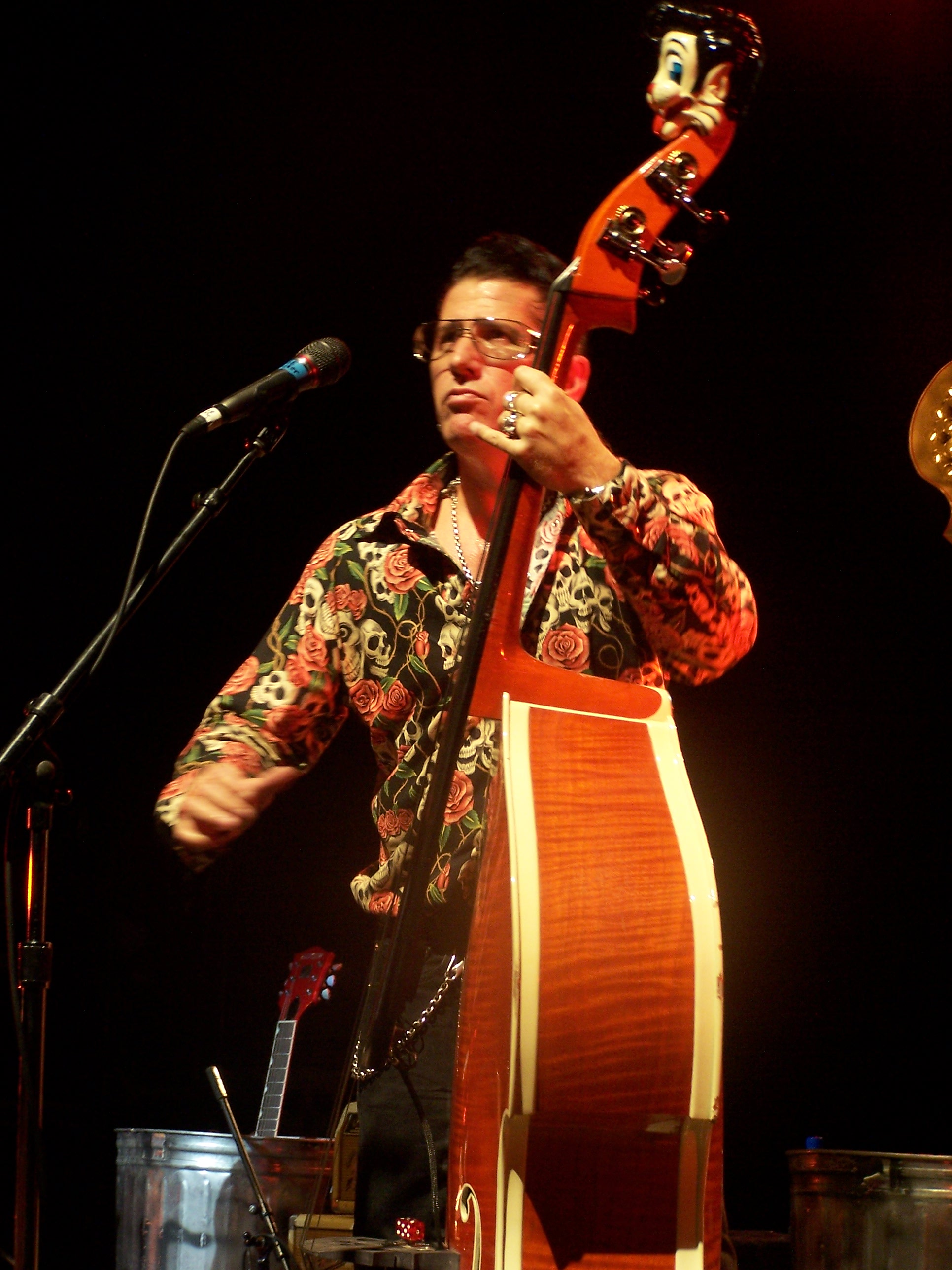
Drucker's school friends included James McDonnell and Brian Setzer. The three of them played together regularly and widened their musical interests to include the blues and rockabilly. Drucker also learned to play the double bass to incorporate the sounds of blues and rockabilly on the acoustic instrument. The three of them formed the group The Stray Cats in 1979. McDonnell took on the stage name of "Slim Jim Phantom", and Drucker devised his own stage name of "Lee Rocker". Rocker evolved his own style of slap-bass playing with the group.
Rocker and the Stray Cats sold nearly 10 million albums and garnered twenty three gold and platinum certified records worldwide, and made them a mainstay on MTV.[citation needed] In addition to Stray Cats, Lee Rocker and Phantom Rocker and Slick albums, Rocker has recorded or performed with Carl Perkins, George Harrison, Ringo Starr, Willie Nelson, Leon Russell, Keith Richards, John Fogerty, and Scotty Moore. Rocker was nominated for a Grammy Award in 1982, as was his father, they are the second father-son duo to be nominated for a Grammy in the same year. He considered to be an influential upright bassist in Rock n' Roll.
Since the break-up of The Stray Cats, Rocker has had a solo career and produced recordings independently. In 1985, Rocker, Phantom and Earl Slick formed the group Phantom, Rocker & Slick and recorded two albums for EMI Records titled Phantom, Rocker and Slick and Cover Girl. The song "Men Without Shame" landed Rocker back on MTV and in the charts. For Black Top Records, Rocker released the albums Big Blue (1994) and Atomic Boogie Hour (1995). He has also recorded for Alligator Records.
He released the album, Bulletproof, in 2003. His other albums included Black Cat Bone, released in August 2007, which featured Brophy Dale on guitar and Jimmy Sage on drums. Buzz Campbell (Hot Rod Lincoln and Sha Na Na) joined the band three years ago, and gave a Gretsch guitar sound to the band. In 2011 Lee released an EP called "The Cover Sessions" which features cover versions of songs such as the John Lennon/Paul McCartney song "Come Together," Elton John's, "Honky Cat," and The Allman Brothers song "Ramblin Man." In addition to recording and touring, Rocker hosted a radio show on XM Radio, called 'Rumble and Twang with Lee Rocker.' He also works in concert promotion with his Texas-based roots music festival, 'Revival Festival.' As of 2011, 'Revival Festival' is now in its fourth year and has proven to be successful. Lee Rocker joined the cast of the Broadway hit “Million Dollar Quartet” as bassist Clayton Perkins, the brother of Sun Records recording artist Carl Perkins in a twelve-show run from January 21 through 31st, 2011. He topped off the show with a special encore performance with the cast and an appearance on New York Today.
2013 has brought Mr Rocker much acknowledgment for his unique and technical style of bass playing with a "Life Time Achievement Award" from Bass Player Magazine as well as teaching master classes in London and Los Angeles. Lee is also a member of the "Long Island Music Hall of Fame" and the recipient of the "Visionary Artist Award" from the Laguna Beach Arts Council.
Rocker and his wife Deborah have two children. Daughter Sadie is an artist living in California. His son, Justin, is a screenwriter, who attended Chapman University where he was vice president of the Alpha Delta Phi fraternity. The family resides in Laguna Beach, California and New York City.
Clint miller (1950)
Isaac Clinton „Clint“ Miller (* 24. Mai 1939 in Ferguson, North Carolina) ist ein US-amerikanischer Politiker, Jurist und Rockabilly-Musiker.
Miller wuchs mit sechs Geschwistern in einfachen Verhältnissen auf. Er begann während seiner Schulzeit in Woodstock, Virginia mit Freunden zu singen und ließ sich dabei von Country-Größen wie Eddy Arnold oder Carl Smith beeinflussen. In Washington D.C. konnte er seine Sangeskünste im Lokalfernsehen zeigen.
Im Herbst 1957 unterzeichnete er einen Vertrag bei ABC-Paramount, die vergeblich versucht hatten, die Masterbänder des gerade von Johnny Faire eingespielten Rockabilly-Songs Bertha Lou von dessen Produzenten Kenny Babcock von Surf Records zu erwerben. ABCs A&R-Manager Don Costa entschied daher, mit Miller als Sänger den Titel im New Yorker Bell Sound Studio einzuspielen, der zusammen mit dem Original Anfang Dezember 1957 auf den Markt kam und aufgrund einer geschickten Promotion unter anderem über Dick Clarks Show American Bandstand mit einem 79. Platz der Billboard-Charts erheblich erfolgreicher wurde. Als B-Seite wurde der Carl-Smith-Hit Doggone It Baby, I’m in Love aus dem Jahr 1954 gecovert. Clint konnte auch weiterhin regelmäßig im Fernsehen auftreten und gehörte zum Programm der regelmäßigen Country-Tanzveranstaltung Town and Country Jamborees in Washington.
Im Juni 1958 ergab eine zweite Aufnahmesession Material für zwei Singles, darunter der tanzgeeignete, etwas poppigere Teenage Dance und mit Polka Dotted Poliwampus ein Novelty-Answer-Song auf Sheb Wooleys Purple People Eater. Nach einer Single für Big Top Records ging Miller zum New Yorker Label Headline Records, wo er zwischen 1959 und 1961 vier weitere Singles veröffentlichte. 1962 folgten zwei Platten für Lenox Records.
Während seiner Zeit als Musiker trieb Miller seine Hochschulausbildung voran. 1961 besuchte er die Stella Adler Studio of Acting, 1962 erreichte er an der American University einen Abschluss in öffentlicher Verwaltung. 1965 bestand er in Lexington ein juristisches Examen, auf das er seine weitere Laufbahn baute. 1972 wurde er für die Republikanische Partei in das Abgeordnetenhaus von Virginia gewählt, dem er bis 1993 angehörte. In diesem Jahr bewarb er sich erfolglos um die Nominierung seiner Partei für die Gouverneurswahlen, die stattdessen an George Allen ging. Bis zu seiner Pensionierung im Jahr 2006 arbeitete er als Richter in der Virginia State Corporation Commission.
Die Musik betrieb er während seiner politischen Karriere nur noch nebenher. 1976 nahm er eine Single auf und erst 1993 stellte er drei Songs auf einer CD zusammen.
สมัครสมาชิก:
บทความ (Atom)